


What does full-spectrum LED mean?
Visible light covers wavelengths from approximately 380 to 700 nm. Natural daylight contains a balanced distribution of energy across this entire range.
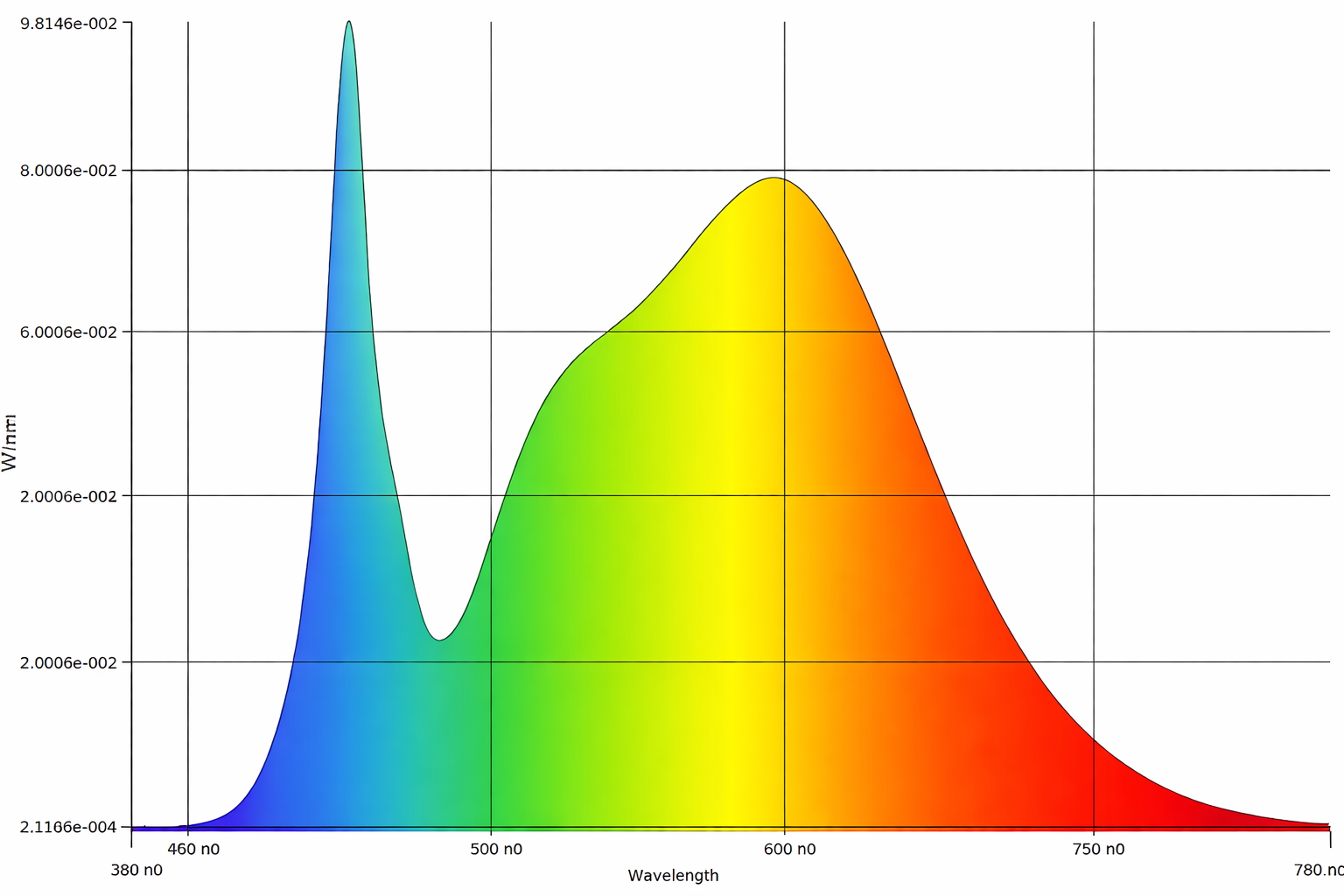
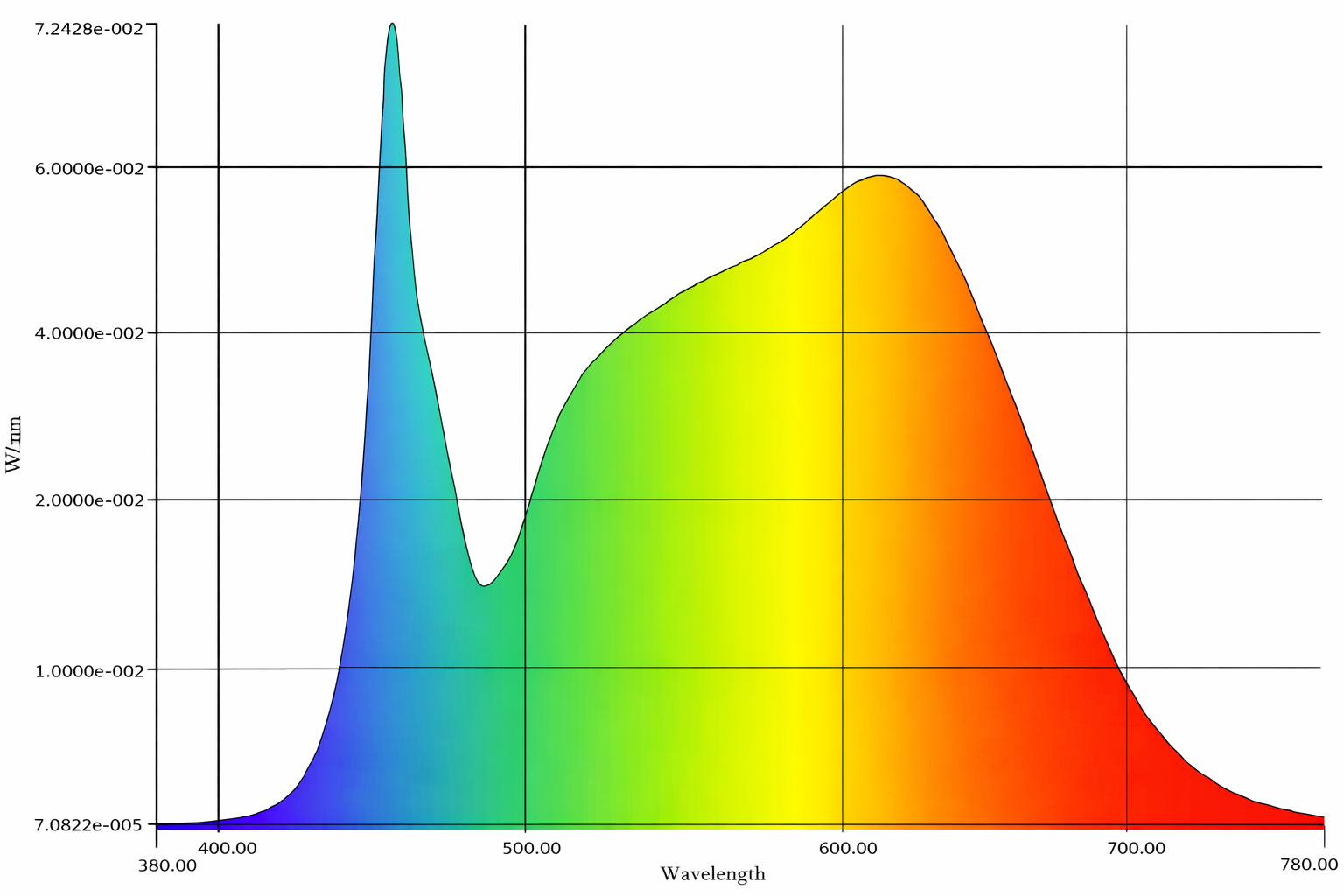
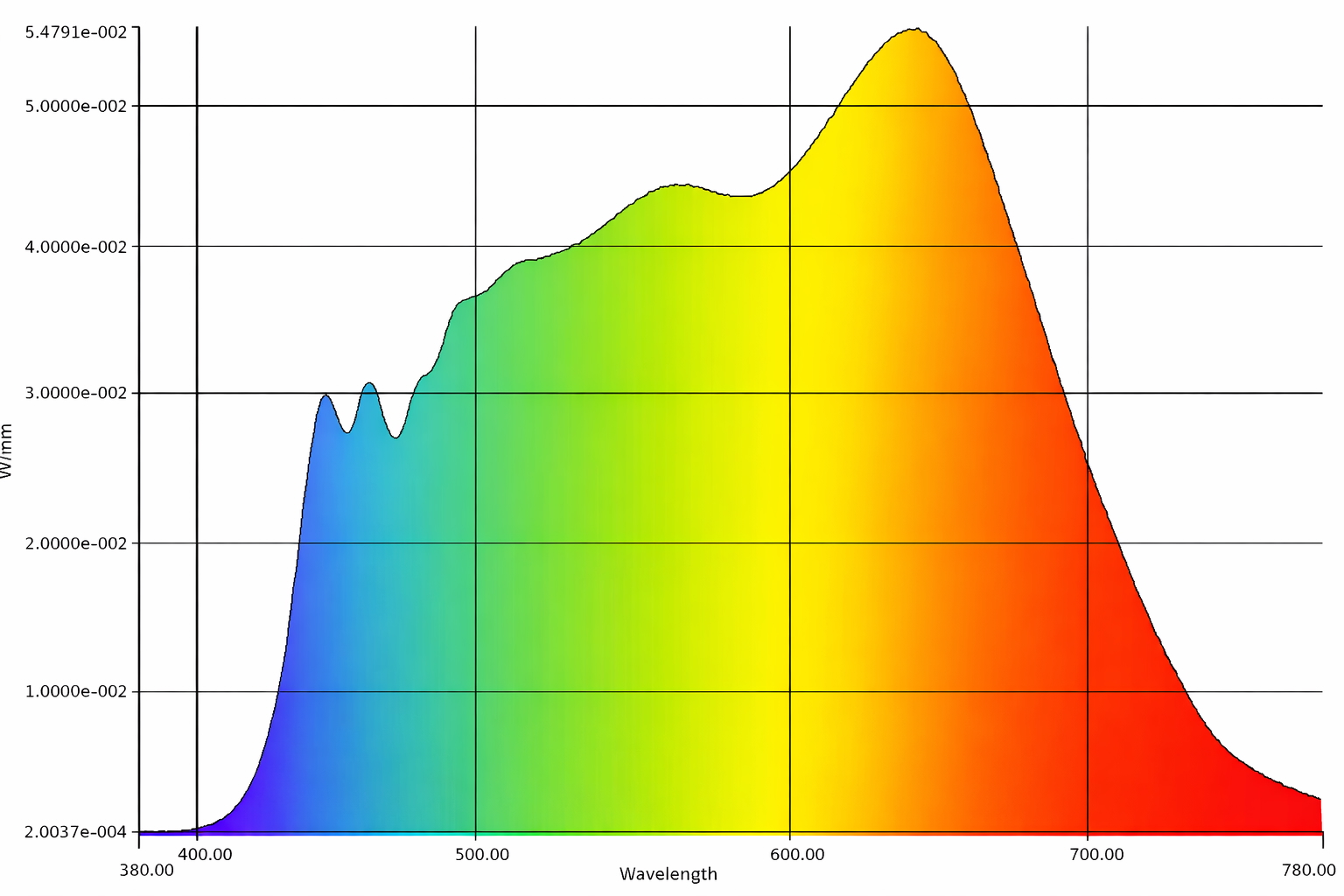
A full-spectrum LED source is engineered so that its spectral power distribution closely mimics this natural pattern — with a smooth curve and no significant gaps between wavelengths. MODUS SUN operates in the range of approximately 425–690 nm, with minimal spectral deviation from the ideal daylight curve.
Full spectrum is not a marketing term — it is a technical characteristic of a light source. It is measured by comparing the spectral power distribution against a reference source, in this case natural daylight.
Light affects humans through two pathways. The first is visual — it allows us to see. The second is non-visual, and until recently was scientifically underestimated: light influences biological processes in the body through specialised receptors in the retina, regardless of what we are looking at.
This second channel — the so-called non-visual system — is today one of the most actively researched areas in lighting science. And spectral composition plays a decisive role within it.
More about the research at the end of this article.
Three parameters that define MODUS SUN
The quality of a light source for demanding applications cannot be described by a single number. MODUS SUN is defined by a combination of three interrelated parameters:
CRI 97
The colour rendering index expresses how faithfully a source reproduces the colours of test samples compared to a reference illuminant. A value of 97 is at the upper limit of what current LED technology offers for commercial applications. It means exceptionally accurate colour rendering across the entire spectrum.
High R9
R9 is a special index measuring the rendering of saturated red — a region of the spectrum that directly affects the perception of skin tones, food, textiles, and warm colour shades. MODUS SUN achieves high R9 values, making it a suitable choice for applications where faithful rendering of these tones is critical.
Smooth spectral power distribution
Even a high CRI value does not by itself guarantee a balanced spectrum. Two sources with the same CRI can differ substantially in their spectral power distribution. The full-spectrum curve of MODUS SUN ensures that the result is accurate and natural even where a source with comparable CRI might still distort the colour impression.
Parameter overview by source class
A reference comparison for specification decisions:
| Parameter | Standard Ra80 | Standard Ra90 | MODUS SUN (CRI97) |
|---|---|---|---|
| CRI | 83 | 93 | 97 |
| R9 (CRI#9) | 10 | 70 | 95 |
| Dominant wavelength (nm) | 454 | 456 | 637 |
| Efficacy (lm/W) | 178 | 164 | 112 |
| Spectral power distribution | Standard | Variable | Smooth, full |
| Suitability for demanding applications | No | Partially | Yes |
 |
 |
 |
Note: The higher spectral quality of MODUS SUN comes at the cost of lower efficacy. MODUS SUN is chosen deliberately for applications where light quality matters more than maximum source efficiency.
Available colour temperatures
MODUS SUN is available in three chromaticity variants covering different application types.
3000 K — warm light for comfortable environments
A spectrum closer to evening daylight. Suitable for beauty salons, hair salons, receptions, premium interiors, and residential care facilities for elderly residents.
4000 K — neutral light for everyday work
A versatile choice for spaces that combine visual comfort with accurate colour rendering. Suitable for offices, schools, medical practices, and retail environments with extended occupancy.
5000 K — light closest to the daylight spectrum
For environments where accurate colour assessment is a key project requirement. Suitable for graphic studios, print shops, laboratories, and inspection workstations.
First available configuration: FIT3000AKN4SUN/ND (4000 K, CRI97, full spectrum, 3,100 lm, 34 W). Higher-output variants in the 4,000–6,000 lm range are in preparation.
MODUS SUN in the product portfolio
MODUS SUN technology is available across the MODUS range — from office luminaires to industrial and designer series:
- Office and interior luminaires: FIT · IBP · LLL · KX
- Industrial luminaires: GAME · PL · TOP · VLO
- Designer luminaires: EXAL · GEO · DON · HL · HLS · HEX
- Floor-standing luminaires: FSQ · FSDON
For availability of MODUS SUN in specific series and configurations, please contact your MODUS sales representative or the technical department directly.
Combined installations
Full-spectrum luminaires do not need to be deployed throughout an entire building. They deliver the greatest added value when used selectively — at points where light directly affects the outcome: sales counters, workstations, examination rooms, or presentation zones.
Combining standard MODUS luminaires for general illumination with MODUS SUN in key zones makes it possible to achieve a strong visual result while optimising overall project costs. This approach is common in retail projects and in interiors with higher lighting design requirements.
MODUS SUN is also suitable for projects certified under WELL or LEED standards, where spectral light quality is one of the assessed parameters for indoor environmental quality.
Why spectrum matters: arguments for specific environments
For sales partners and technical staff recommending MODUS SUN to investors and facility operators, here is a summary of the key arguments by environment type.
Schools and educational spaces
Pupils and students spend 5–8 hours a day under artificial lighting. Research shows that the spectrum of light influences concentration, cognitive performance, and fatigue levels — especially in sleep-restricted adolescents (Frontiers in Neurology, 2021).
- Full-spectrum light supports natural alertness without requiring higher illuminance levels
- Accurate colour rendering improves the legibility of materials, maps, charts, and presentations
- Argument for the investor: light as part of educational environment quality — not just a compliance checkbox
Healthcare facilities
In healthcare, the spectrum of light has a direct impact on two things: the accuracy of visual assessment and the wellbeing of both patients and staff.
- Dental practices, dermatology: accurate rendering of tissue colours, dental materials, and skin lesions
- Long shifts for healthcare workers: full spectrum supports alertness and reduces visual fatigue
- Patients in wards: light close to the daylight spectrum helps maintain circadian rhythms in immobile patients
- Argument for the investor: the WELL standard and WHO guidelines include spectral light quality for healthcare environments
Care homes and residential facilities
Elderly residents are the group for whom the lighting environment has the most well-documented impact on biological function. With age, lens transmittance for shorter wavelengths declines, melanopsin sensitivity decreases, and circadian rhythms destabilise.
- Full-spectrum light is the most effective available tool for supporting circadian rhythms in immobile elderly residents
- Research documents improvements in sleep quality, reduced night-time disorientation, and milder cognitive decline
- Argument for the investor: lighting in care homes is increasingly discussed as a therapeutic intervention, not merely a technical specification
Offices and open-plan workspaces
Modern office environments increasingly involve hours spent without access to natural daylight. Research from real office settings consistently confirms that spectral light quality affects fatigue, productivity, and sleep quality among employees.
- Full-spectrum LED reduces fatigue at the same illuminance levels
- Better employee sleep quality = lower absenteeism and higher performance
- Argument for the investor: WELL and LEED certification schemes include spectral light quality as an assessed parameter for indoor environmental quality
Light is more than lux: what research tells us about the effect of spectrum on humans
Melanopsin: the receptor that has nothing to do with vision
In 2002, a third type of light-sensitive cell was discovered in the human retina — intrinsically photosensitive retinal ganglion cells (ipRGCs), containing the pigment melanopsin. These cells directly connect the eye to the brain regions responsible for circadian rhythms, melatonin secretion, and alertness.
Unlike rods and cones, they do not serve to form a visual image. They serve to synchronise the body's biological clock with the external environment.
Light close to the natural daylight spectrum provides the melanopsin system with the signal that the human organism is evolutionarily calibrated for. Light with an unbalanced spectral power distribution distorts that signal.
What the research demonstrates
The influence of spectral composition on human biological function is today supported by dozens of independent studies from leading research institutions worldwide. Below is a selection of relevant findings:
Stanford University, 2022 — Cognitive performance and full-spectrum light
A controlled study showed that daytime exposure to full-spectrum LED light improves several aspects of cognitive performance directly — not merely through changes in alertness. The key mechanism is stimulation of the melanopsin system.
View study →
MDPI Sustainability, 2026 — Fatigue and reaction speed in office settings
A laboratory experiment with 40 adults demonstrated that full-spectrum LED reduces fatigue and maintains cognitive reaction speed at the same illuminance as conventional LED. Full spectrum functions as a quality factor independent of illuminance level.
View study →
Frontiers in Neurology, 2021 — Sleep-restricted students
A comparison of standard and full-spectrum LED (3000 K and 5000 K) in sleep-restricted students. Full-spectrum light improved cognitive performance even at low intensity (approx. 50 lux). Results support the use of full-spectrum light in classrooms where students spend entire mornings.
View study →
Journal of Pineal Research, 2021 — Melatonin and dynamic lighting (University of Basel)
Stefani, Cajochen et al.: dynamic changes in light spectrum and intensity across the day demonstrably increase evening melatonin secretion and reduce sleep onset latency. Static lighting at the same intensity does not produce this effect.
View study →
Scientific Reports / EPFL Lausanne + University of Basel, 2022 — Office lighting and circadian phase
Office lighting optimised for its melanopic component advances the melatonin onset and improves thermoregulation before sleep — two key parameters of sleep quality and recovery.
View study →
ScienceDirect, 2025 — Four-week field experiment in a real office
15 participants, IoT-controlled lighting, real office environment. Dynamic lighting mimicking the natural progression of daylight increased nocturnal melatonin secretion by 1.5× compared to static lighting. Poorly designed static lighting reduced it by up to 3.7×.
View study →
Meta-analysis, Jinan University, 2022 — Alertness and CCT
A systematic meta-analysis confirmed that light with higher correlated colour temperature — closer to the daylight spectrum — demonstrably improves both subjective and objective alertness. The mechanism operates through the melanopsin system and the suprachiasmatic nucleus of the hypothalamus.
View study →
Ball State University, 2023 — Windowless office
A crossover study with 32 employees in offices without access to natural daylight. LED lighting with a smoother spectral power distribution led to demonstrably better sleep quality and reduced daytime dysfunction compared to fluorescent lighting of comparable intensity.
View study →
Scientific consensus on the impact of light on biological processes is consolidating rapidly. Leading research institutions — University of Basel, Stanford, EPFL Lausanne — now consistently confirm that spectral composition of light has demonstrable effects on alertness, cognitive performance, melatonin secretion, and sleep quality.
Light quality affects more than just vision.
MODUS SUN extends the proven MODUS product portfolio with a variant for applications where spectrum matters — both in terms of colour fidelity and the biological impact of light on the human body. The same luminaires you know — with technology that goes further.
Available in 3000 K / 4000 K / 5000 K variants across the MODUS product portfolio.